Developer blog
AI Video Translator vs Translation Service: Which Fits Your Course?
The question usually gets framed as software against people, which is the wrong frame. Both options end with a translated video, and both involve software and people. The difference is who holds the pen, and who carries the blame when lesson 14 goes out with the old price still in it.
This is a decision about operating models rather than features. Pick the model first, then shop inside it.
Start here
| Your situation | Model that fits | Why |
|---|---|---|
| Internal training, a handful of lessons, no external audience | Self-service | The cost of a small error is a Slack message, not a refund |
| Course text changes every month | Self-service | Agency turnaround gets spent re-quoting the same lessons |
| You have a fluent colleague in each target market | Self-service | You already own the only expensive part |
| Nobody on staff reads the target language | Service, or self-service with hired reviewers | Someone qualified has to read it before learners do |
| Customer-facing certification, medical, financial, legal | Service | You are buying accountability and a paper trail |
| Marketing content where tone matters more than accuracy | Service | Transcreation is a writing job rather than a translation job |
| Named on-camera talent, studio voice casting, lip sync | Service | Production work that self-service tools do not do |
| 40 lessons, 6 languages, quarterly refresh, one internal reviewer | Hybrid | Machine drafts, your reviewer approves, an agency handles the two regulated modules |
The sections below are the reasoning behind those rows.
What each option includes
A self-service AI video translator gives you a pipeline and a seat in front of it. Transcription, translation, synthetic voices, subtitles, and a place to correct the machine before it speaks. Nobody checks your work. The tool cannot tell you that the German translation of your compliance line is technically accurate and legally useless, because the tool has no opinion.
A translation service sells process and accountability. The useful reference point is ISO 17100:2015, the standard for translation services. It requires that every translation is revised by a second person, and it sets qualification routes for translators and revisers. That second pair of eyes is the product. Agencies also carry a project manager, a terminology owner, and someone whose job is to answer for a mistake.
Note one thing about that standard: raw machine translation plus post-editing sits outside its scope. Post-editing has its own standard, ISO 18587:2017, which covers full human post-editing of machine output and what a post-editor has to be able to do. If a vendor waves ISO 17100 at you while running an MT pipeline, that is a question worth asking out loud.
Sales conversations blur three different jobs, so separate them yourself. Translation is text work. Dubbing puts a new voice on the timeline. Production covers casting, direction, sound design and anything done to the picture. A tool can be good at the first two and not do the third at all.
Seven factors that settle it
1. Who owns quality
This is the factor that settles most of the others. If your organization has someone who can read the target language and is willing to sign off, self-service works and gets cheaper every month. If it does not, you have to buy that person, and hiring a freelance reviewer per language is still a service purchase, just an unbundled one.
2. Update cadence
A course that never changes is a one-time project, and projects are what agencies are built for. A course that changes monthly is a process, and a per-project vendor relationship taxes every single change with a quote, a PO and a wait. Four revision cycles a year means four rounds of that overhead, whether or not the underlying text moved much.
3. Lesson count
Volume changes what breaks. Ten lessons fit in your head, sixty do not, and past that point you need a screen that tells you which lesson in which language is finished, stale or failed. Ask any vendor, software or human, to show you that view: an agency will show a project tracker, a tool should show a grid.
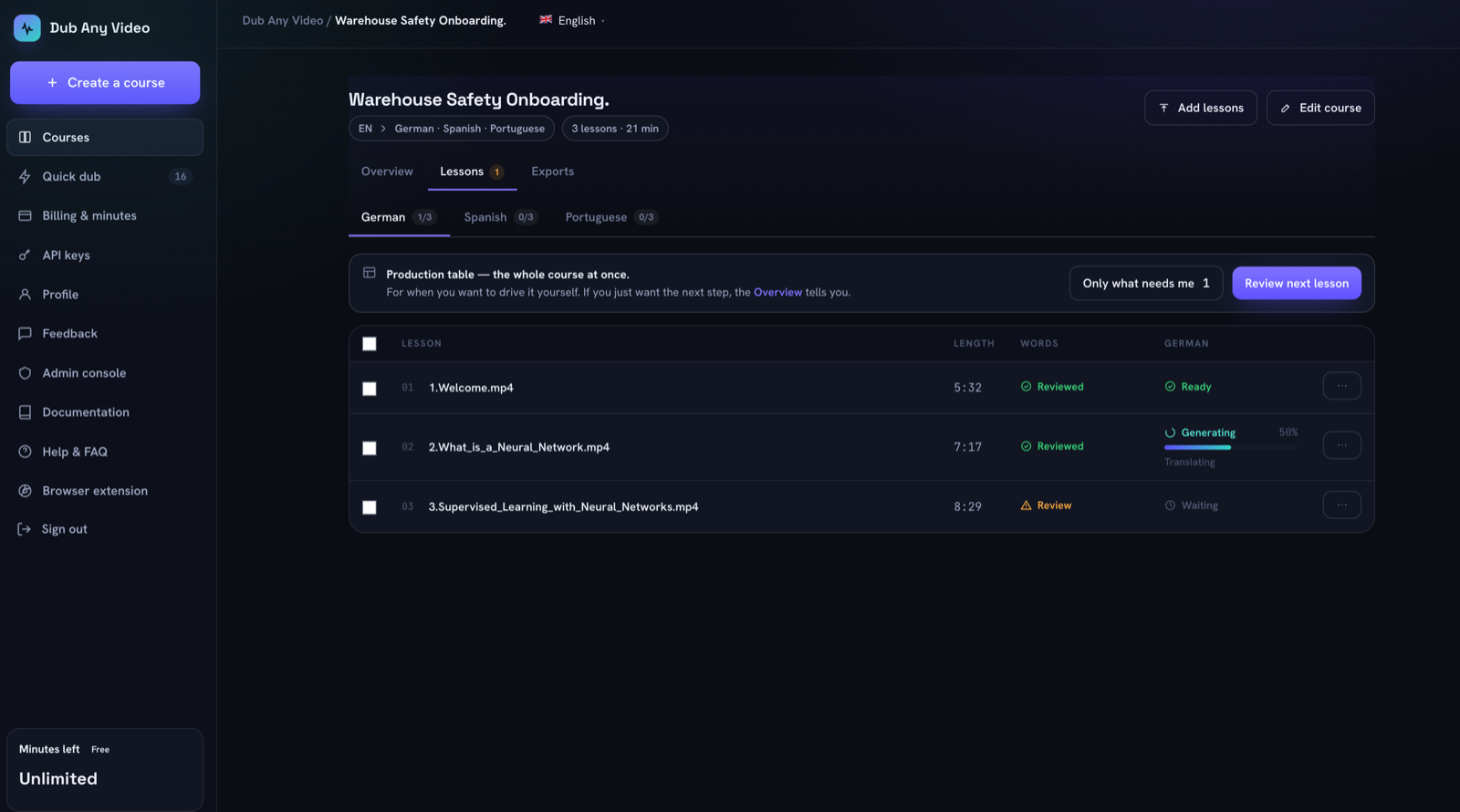 The view an agency replaces with a project tracker: every lesson and language pair carrying its own state.
4. Languages
Two languages you can manage by hand. Ten is a supply chain whichever model you pick. Agencies scale by adding vendors, which is why per-language quality varies and why it is worth asking who specifically does Portuguese. Self-service scales by copying settings, which is fast and reproduces your terminology mistakes across every market at once.
5. Reviewer capacity
Be honest about hours. Reviewing a translated 12-minute lesson properly takes longer than watching it. Multiply that by lessons, by languages, by revision rounds. If the total is larger than the hours your team has, self-service will not come out cheaper, because the review either slips or gets skipped.
6. Production scope
Voice cloning, lip sync, on-screen text, slide decks, quiz banks, and LMS packaging are separate jobs. Self-service tools generally handle audio and subtitles and stop there. If your course lives inside slides with burned-in text, budget for that work regardless of which model you choose.
7. Compliance
Regulated content needs a name on the approval and a record of who approved it. Some buyers need certified or sworn translation, which is a legal artifact that no software produces. If a regulator or a customer contract is in the picture, that requirement decides the model on its own.
Disclosure is a separate duty from accuracy, and it now has dates attached. Article 50 of the EU AI Act applies from 2 August 2026 and requires synthetic audio, image, video and text to be marked in a machine-readable form, with systems already on the market given until 2 December 2026 for the marking part. Ask every candidate the same plain question: does the delivered audio carry Content Credentials or any other embedded provenance, and will you say so in writing? Agencies subcontract generation too, so the answer has to come from whoever runs the model.
What it costs, without the fake numbers
We are not publishing a price comparison, because honest ones do not exist. Agency quotes depend on language pair, subject matter, turnaround and volume, and any table claiming otherwise is decoration. What you can compare is where the money goes.
Agency spend is one visible line: a quote per minute or per word, plus revision rounds. It is easy to forecast and easy to defend to finance. What it hides is your own coordination time, which is real and rarely tracked.
Self-service spend is four lines and only one of them lands on a card statement: the per-minute processing cost, the setup you pay once per course, the review time that comes out of somebody's salary, and the rework you do when nobody defined terminology before generating 60 lessons.
Rework is the line that decides whether self-service was actually cheaper. It is also the one you control, by fixing terms and speaker assignments once at the start rather than lesson by lesson later.
The hybrid: machine draft, human approval
This shape survives contact with a real course, and it is common enough to have its own ISO number.
The workflow is unglamorous. Generate the transcript and translation, export the text, send it to a professional linguist for the languages that matter, paste the corrections back, then voice it. The human gets paid for judgment on the text rather than for typing the first draft of it.
For this to work, your tool has to let text out and back in. Without exports of transcripts and translations as subtitle files, there is no handoff to make.
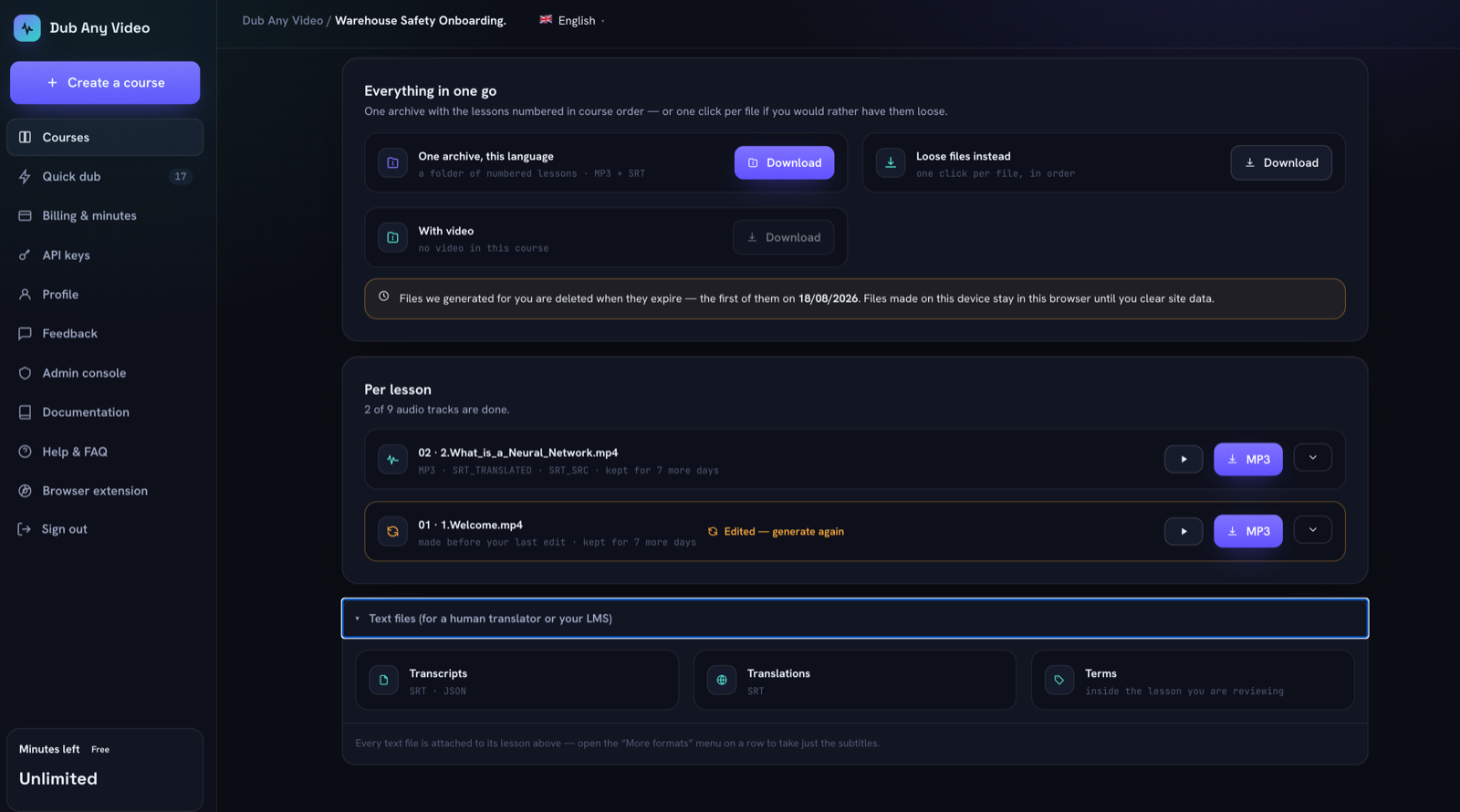 Transcripts as SRT or JSON, translations as SRT, labeled for a human translator or your LMS.
You can also split by risk instead of by task. Route the two compliance modules to an agency and run the other 38 lessons in-house. Nothing requires one model for a whole catalogue.
Three courses, three answers
Five-lesson internal onboarding, two languages, staff already bilingual
Self-service, no discussion. Total spend is a few hours of processing and a colleague's afternoon. An agency quote for this would arrive after the course was already localized.
SaaS academy, 45 lessons, six languages, product ships monthly
Self-service as the base, with paid reviewers per language on retainer. Cadence decides this one. A quarter of your lessons change every quarter, so a tool that tells you which localized outputs no longer match their edited source is worth more here than a better voice.
Customer-facing certification course in a regulated industry
Service. You need qualified linguists, revision by a second person, an audit trail, and someone contractually answerable. Use a self-service tool to build the internal draft if you like, then hand it over. Do not ship machine output to a regulator.
Pilot one lesson, not the catalogue
Whichever way you are leaning, buy one lesson before you buy 40. Pick a representative one: your actual vocabulary, your actual speaker, at least eight minutes long.
Send the same lesson to the shortlisted agency and run it through the self-service tool yourself. Then have the same reviewer, ideally a native speaker who knows the subject, grade both without knowing which is which. Count the corrections they make per minute of runtime, and time your own hours on each path. Ask the agency what changes at 40 lessons and get the turnaround in writing.
The pilot costs one lesson. The wrong model costs the whole course, twice.
Where we sit, honestly
Dub Any Video is the self-service option. It is a workspace for courses: lessons and languages in one grid, editable transcripts and translations, terminology applied across the course, an approval step before anything is voiced, and per-language exports. A course holds up to 200 lessons and 10 target languages, and it runs either on our servers against a monthly minute balance or locally in your browser for free.
What we are not: an agency, a certified translation provider, or a production house. We do not review your text, we do not clone voices, we do not do lip sync, and we do not touch slides, quizzes or your LMS. Our exports carry no Content Credentials today, so the disclosure question above applies to us exactly as it applies to anyone else. Approval stays with you by design. If you need any of those things, buy them from someone who sells them, and see the comparison pages for where competitors beat us.
FAQ
Is an AI video translator good enough for customer-facing courses?
For the draft, usually. For the final approval, only with a qualified human reading it in the target language. Software can produce the draft, but it cannot be accountable for what your learners are told.
Do agencies use AI anyway?
Many do, under post-editing standards. That is fine, and it is often what you are paying for: the machine draft plus a qualified person fixing it. Ask what their process is and which standard it follows rather than whether machines are involved at all.
Can I switch models later?
In one direction, easily. Corrected text exports as subtitle files and can go to an agency at any point. Going the other way is harder, because agency output usually arrives as finished files rather than editable project state.
Who has to label the AI-generated audio?
Article 50 puts the machine-readable marking duty on the provider of the system that generates the content, and separate disclosure duties on the deployer who publishes it. Assume you will have to disclose, and ask your vendor in writing what marking its output carries.
What about certified or sworn translation?
No software produces it. It requires an authorised human translator and a signature. If your buyer needs one, that part of the work is a service purchase.
Which is faster?
Self-service is faster to start and faster to change. Agencies can be faster to finish when a lot of languages run in parallel with their own reviewers. Get real turnaround commitments before treating either claim as fact.
Decide the model, then the vendor
It is easy to make this decision backwards, starting from a demo instead of from your own workflow. Answer two questions first: who reads the target language before your learners do, and how often this course changes. Those two answers pick the model, and the vendor shortlist follows from there.
If you land on self-service, the buyer's checklist covers what to test. If you have never run a course through this kind of workflow, the walkthrough shows the whole path on one lesson.